You have had this body for a while now. In fact, you've had it for decade, which means you know how you sleep, how you think, what your period tends to do and roughly how much fuss to expect from it. You know what a normal week feels like, what tired feels like, what stressed feels like and, perhaps most importantly, what an ordinary Tuesday feels like inside your own head.
Then, somewhere in your forties - and sometimes in your late thirties - the body you thought you knew so well starts quietly freelancing.
The period that used to arrive like a reasonably reliable houseguest begins making its own travel arrangements, sleep becomes something you apparently have to negotiate for, and your memory develops a slightly questionable sense of humour. You might walk into a room and forget why you are there, find yourself wide awake at 3 am for absolutely no useful reason, or suddenly feel as though someone has turned the heating up while everyone around you appears completely comfortable.
At no point, apparently, was anyone planning to call a meeting about this.
Welcome to the Zone of Chaos.
There is a name for this, and it really would have been useful if somebody had mentioned it
The name is perimenopause, which is the transition leading up to menopause. Menopause itself is reached after 12 consecutive months without a period, while perimenopause commonly begins in the mid-forties, although it can start in the late thirties, and often lasts somewhere around four to eight years.¹˒²
One of the more confusing parts is that your hormones do not simply begin a smooth, graceful decline towards menopause. Instead, they fluctuate, sometimes quite unpredictably, which helps explain why this stage can feel less like a tidy biological transition and more like somebody has shuffled the instruction manual.²
That is also why the first recognisable clue is often not that your period suddenly stops. More commonly, the cycle you thought you knew begins changing its timing, length, flow or general attitude towards punctuality.¹
So why did nobody warn us?
It is a fair question because, statistically, a lot of women reach this stage feeling seriously under-informed about what is coming.
Research has found that many women know relatively little about perimenopause before symptoms begin, while surveys also suggest that a significant number feel unprepared for the impact those changes can have on everyday life.³˒⁴ One recent consumer survey reported that many women aged 40 to 49 had not understood what perimenopause was before experiencing it themselves, with a large proportion saying they felt unprepared for how disruptive the transition could be.⁴
When you think about it, that is quite remarkable. We learn about puberty, we learn about periods, and most of us receive no shortage of information about pregnancy and contraception, yet this enormous hormonal transition in the middle of adulthood has often been covered with little more than a vague mention of hot flushes.
The apparent plan was that we would simply work it out when we got there.
A heads-up would have been nice.
It is not usually one symptom that gives the game away
Part of what makes perimenopause difficult to recognise is that it can affect several areas of life at once, including periods, temperature, sleep, mood, memory and concentration.⁵
It also rarely arrives with one enormous neon sign announcing THIS IS PERIMENOPAUSE, which would admittedly make things considerably easier.
Instead, you might notice that you are sleeping badly for a while, then your period starts turning up earlier or later than expected, then you are suddenly much hotter than usual, and somewhere in the middle of all that you forget a perfectly ordinary word halfway through a sentence and find yourself describing a colander as “the pasta bowl with the holes”.
Each thing on its own can be easy to dismiss because life already gives us plenty of explanations for being tired, distracted, irritable or forgetful. When several changes begin happening together, however, they can start to form a much clearer picture.
Hot flushes are a good example of what can be happening underneath. Changes in oestrogen during the menopause transition are thought to affect the brain's temperature regulation, which can mean that relatively small changes in body temperature trigger a much bigger heat response than they once did.⁵
This goes some way towards explaining the deeply glamorous experience of suddenly needing to remove three layers of clothing while everybody else in the room continues with their day as though nothing unusual is happening.
Stress can muddy the waters too
One of the frustrating things about perimenopause is how easily its signs can overlap with the ordinary demands of life.
Poor sleep can be blamed on stress, difficulty concentrating can be put down to having too much on your plate, and changes in mood can be dismissed as the natural consequence of juggling work, relationships, children, ageing parents or whatever else happens to be sitting on your mental to-do list that week.
Even cycle changes can be shrugged off because, well, bodies are weird sometimes.
Research suggests that a substantial number of women over 35 are unsure whether what they are experiencing is perimenopause, while many women also report struggling to get clear answers when they first seek help.⁶
That is why knowing your own pattern matters. You have lived in your body long enough to have a reasonable idea of what feels normal for you, and when that normal begins shifting, paying attention to the pattern can be useful information rather than something you need to dismiss.
It can also last much longer than most of us were led to believe
Perimenopause is not necessarily a quick burst of hormonal weirdness followed by an immediate return to business as usual. It is a transition, and for many women that transition unfolds over several years.
In one of the largest long-term studies looking at menopausal vasomotor symptoms, hot flushes and night sweats lasted for a median of around 7.4 years, with longer durations reported among women whose symptoms began earlier in the menopause transition.⁸
That sounds rather different from the vague impression many of us grew up with, where menopause seemed to involve getting a few hot flushes, buying a fan and carrying on.
Understanding that this can be a chapter rather than a random collection of bad weeks can actually be useful because it changes the way you interpret what is happening. Instead of treating every new change as an isolated mystery, you can begin looking at the bigger pattern and deciding what kind of information, support or medical care might help.
What actually helps when everything feels a little chaotic?
One of the most useful starting points is simply understanding what perimenopause can look like because, once you know the signs, it becomes much easier to notice when your own pattern starts changing.
Tracking those changes can help too, and it does not need to turn into another full-time job. Keeping your cycle, sleep, mood and temperature symptoms together in a diary, app or Notes page for a few weeks can make patterns much easier to spot, while also giving you something concrete to refer to if you decide to speak with your doctor.
This is particularly useful when you are sitting under fluorescent lighting in a consulting room and suddenly cannot remember whether the terrible night's sleep you wanted to mention happened last Tuesday or sometime during 2024.
For people aged 45 and over who have typical symptoms alongside changes to their menstrual cycle, clinical guidelines generally recommend identifying perimenopause from the overall clinical picture rather than routinely relying on hormone blood tests.⁷ Your doctor can also talk you through evidence-based options for managing symptoms, including menopausal hormone therapy where appropriate for you.⁷
It is also worth remembering that common does not mean every new symptom should automatically be blamed on perimenopause. If something is persistent, worsening, unusual for you or interfering with your everyday life, it deserves a proper conversation with a healthcare professional.
Where LIFE Peri-menopause fits
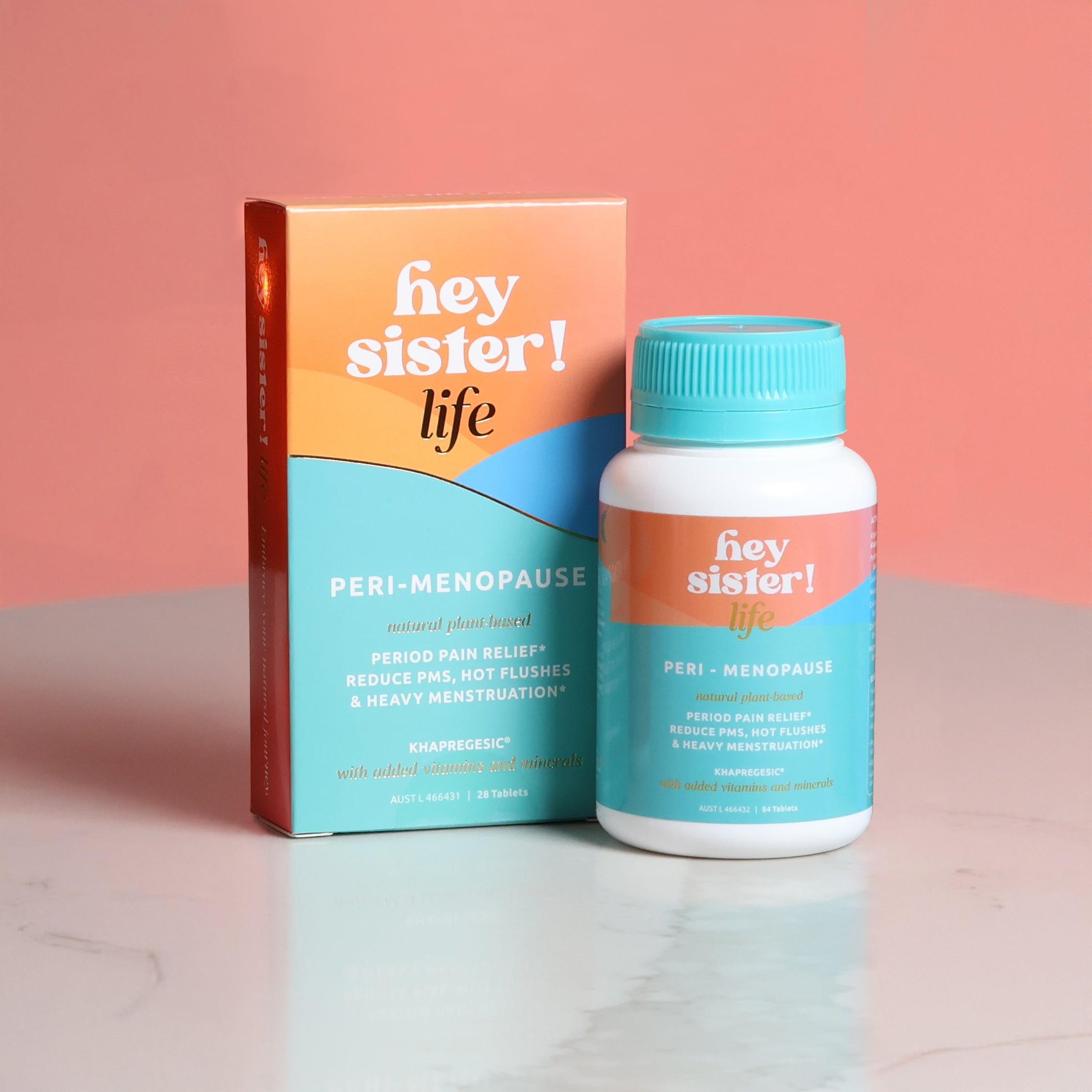
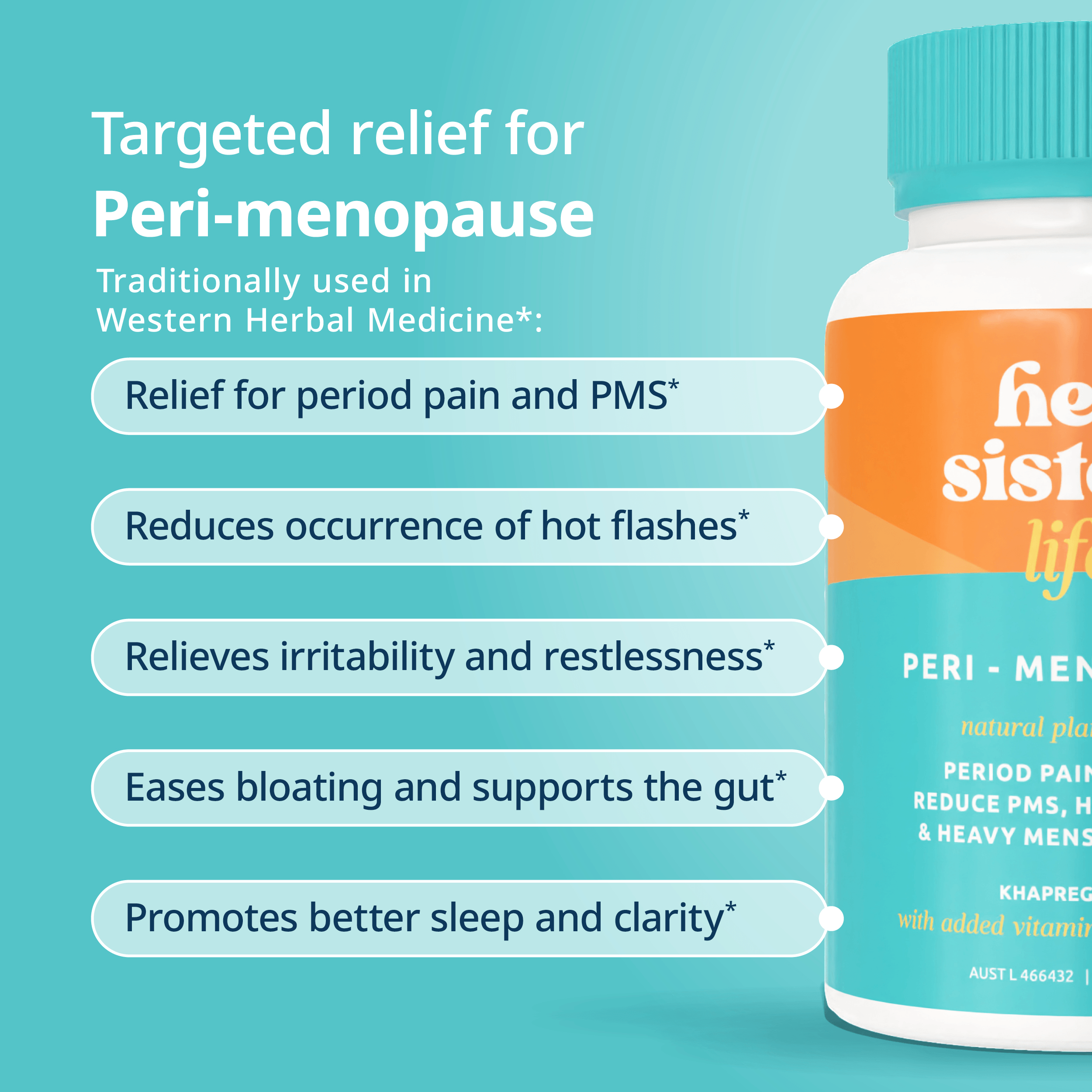
LIFE Peri-menopause sits within the Hey Sister! LIFE range and has been developed for women navigating the perimenopausal transition, when changes associated with periods and menopause can exist in the same rather confusing chapter of life.
Traditionally used in western herbal medicine to relieve symptoms of premenstrual tension and relieve hot flushes associated with menopause.
Always read the label and use only as directed.
Because one of the strangest things about perimenopause is that periods may still be very much part of the picture while menopause-related changes are beginning to make themselves known, which is precisely why this stage can feel so difficult to put neatly into one box. The Hey Sister! TGA Compliance Copy Guide specifically permits LIFE Peri-menopause to carry both premenstrual tension and menopause-related indications, provided those claims stay closely aligned with the listed wording and retain the required traditional medicine statement.
Ultimately, the goal is not to turn every strange Tuesday into another symptom to worry about. It is to understand enough about what is changing that the chaos begins to make a little more sense, while knowing when something deserves a proper check-in with your doctor.
You have spent decades learning how your body tends to work, so it is understandable if this particular update feels as though somebody changed the settings without asking you first.
Perimenopause may be the software update nobody warned us about, but having the new manual makes the whole thing considerably easier to navigate. 🧡
Frequently asked questions
What is perimenopause, exactly?
Perimenopause is the transition leading up to menopause, during which hormone levels fluctuate and periods and other symptoms can begin to change. Menopause itself is reached after 12 consecutive months without a period.¹
When does perimenopause usually start?
It commonly begins in the mid-forties, although some women begin noticing changes in their late thirties. The transition often lasts somewhere around four to eight years, although every experience is different.²
What is usually the first sign of perimenopause?
Changes to your menstrual cycle are often among the earliest recognisable signs, which might mean differences in timing, length or flow. Changes involving sleep, temperature, mood, memory or concentration can also occur during the transition.¹˒²˒⁵
Why can perimenopause be so difficult to recognise?
There is no single universal perimenopause experience, and many of the changes that can occur - including poor sleep, difficulty concentrating, temperature changes and changes in mood or periods - can overlap with plenty of other things happening in everyday life.⁵ Looking at several changes together can often make the overall pattern easier to recognise.
How long does perimenopause last?
It varies considerably between women, although the transition often lasts for several years. Research has also found that hot flushes and night sweats can continue for a median of around seven years, although individual experiences vary widely.²˒⁸
What should I track if I think I might be in perimenopause?
Keeping a simple record of changes to your menstrual cycle, sleep, mood and temperature symptoms can help you see whether a pattern is emerging, while also giving you useful information to take to your doctor if you want to discuss what has been happening.
This article provides general educational information and is not intended to diagnose a health condition or replace advice from your healthcare professional. If your symptoms are persistent, worsening, unusual or affecting your daily life, speak with your doctor.
Always read the label and use only as directed.
References
- Harlow SD, et al. Executive summary of the Stages of Reproductive Aging Workshop +10. Menopause. 2012;19(4):387-395.
- Santoro N. Perimenopause: from research to practice. Journal of Women's Health. 2016;25(4):332-339.
- Harper JC, et al. An online survey of perimenopausal women's attitudes and knowledge of the menopause. Women's Health. 2022;18.
-
Bonafide State of Menopause Survey, 2025. Consumer survey; directional.
- Monteleone P, et al. Symptoms of menopause: global prevalence, physiology and implications. Nature Reviews Endocrinology. 2018;14(4):199-215.
-
npj Women's Health. Perimenopause symptoms, severity and healthcare seeking in US women. 2025.
- National Institute for Health and Care Excellence. Menopause: identification and management. NG23, updated 2024.
- Avis NE, et al. Duration of menopausal vasomotor symptoms over the menopause transition (SWAN). JAMA Internal Medicine. 2015;175(4):531-539.